

"Michael, I have a simple question." Silvia Seven, CFO of FastChangeCo, pushes the project status deck aside. "How many projects have redefined what a 'customer' is from scratch in the last two years?" Michael Mueller swallows. He knows the answer. And it's uncomfortable.
If you don't know Amal, Diego, Michael, and Silvia yet: they're fictional characters from the FastChangeCo universe, which I use to make real challenges from my projects and coaching engagements tangible. Silvia Seven is the CFO — and today she's asking the questions that get asked too rarely in steering committees.
This series spent four parts showing why AI can't automatically create information models, how a hybrid workflow puts AI to genuinely good use, and what this means for the data modeler's role. This bonus article shifts the lens upward: what does all of this mean for the organization — and why is a solid information model not a cost factor, but a strategic asset?
Better models, shorter paths to market
FastChangeCo is planning a new product. The first question in the kick-off: "What customer data do we need?" The answer doesn't come from the data team — it comes from an entity description someone put together three years ago. It's half current, half outdated, and nobody knows quite which half is which. Two weeks of clarification work, before the actual project has started.
This isn't an exception. It's the default scenario in organizations that don't have a well-maintained information model. And it has a direct impact on time-to-market.
The difference between an organization with a solid information model and one without shows up not only in the quality of the end product — but in the time it takes to get there. A good information model improves both: the quality of the data and the speed at which you reach results. An organization that has to re-clarify its core business objects from scratch with every new requirement systematically loses ground to one that only has to extend them.
Think about what that actually means in practice. When the information model for "Customer," "Product," and "Contract" is already cleanly defined, documented, and accessible, the start of every new project shortens — by weeks, not days. The questions that would otherwise eat up the first sprint are already answered. The team can start building instead of first trying to understand.
With AI support, this advantage sharpens further. An organization that has built its information model as a metadata foundation can use AI to generate physical models for new technologies in hours. One without that foundation starts from scratch every time — manually, slowly, and error-prone.
The cost of inaction
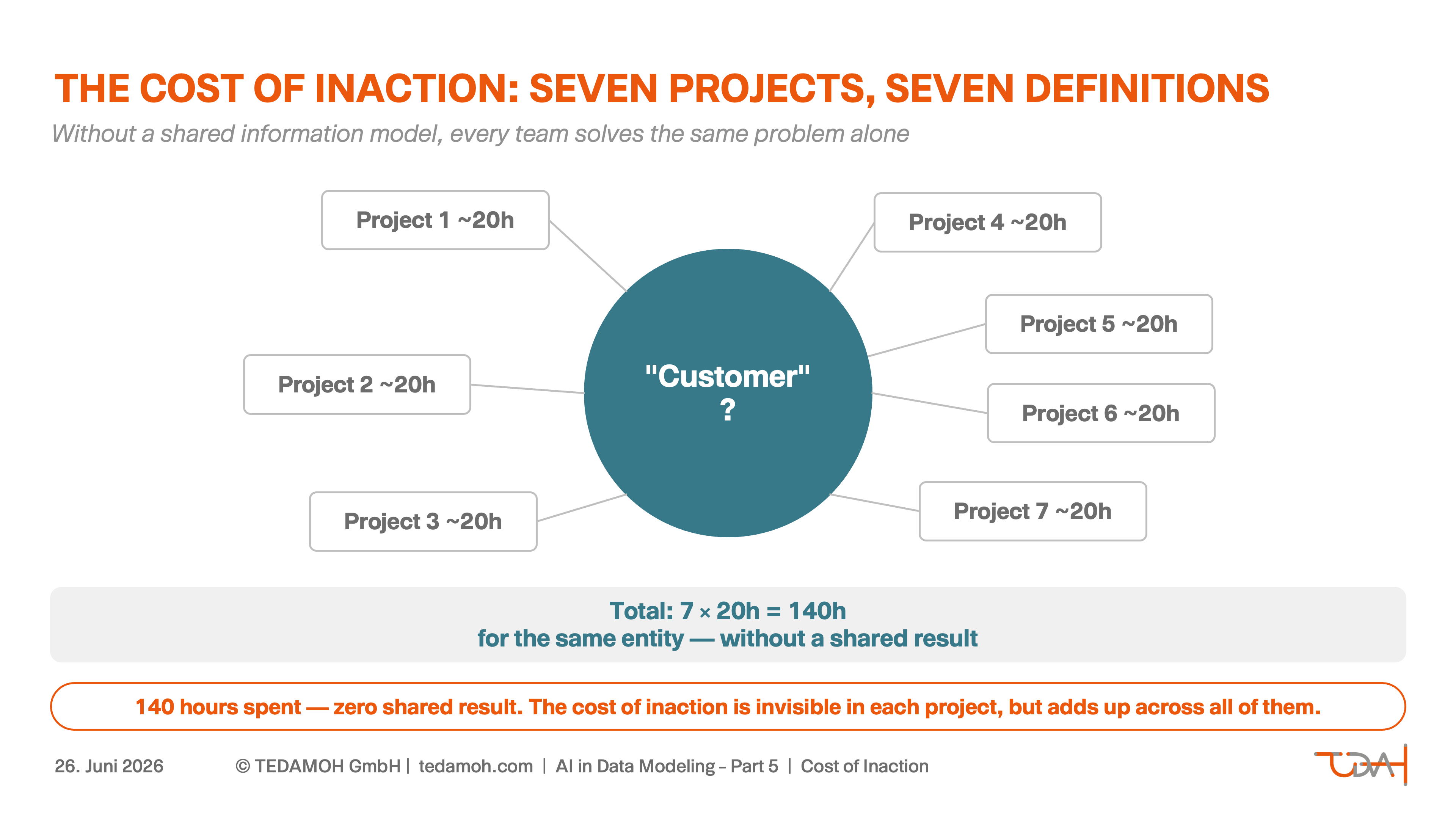 Silvia's question about the last two years had a reason. Michael can answer it: seven projects independently defined what a "customer" is at FastChangeCo during that period. The same problem, solved seven times over — seven different answers, sitting in seven different systems, built by teams that never compared notes.
That is the actual cost calculation of inaction. Not the one-time effort of building an information model, but the sum of all projects that redo the same work over and over — without knowing about each other and without a shared result.
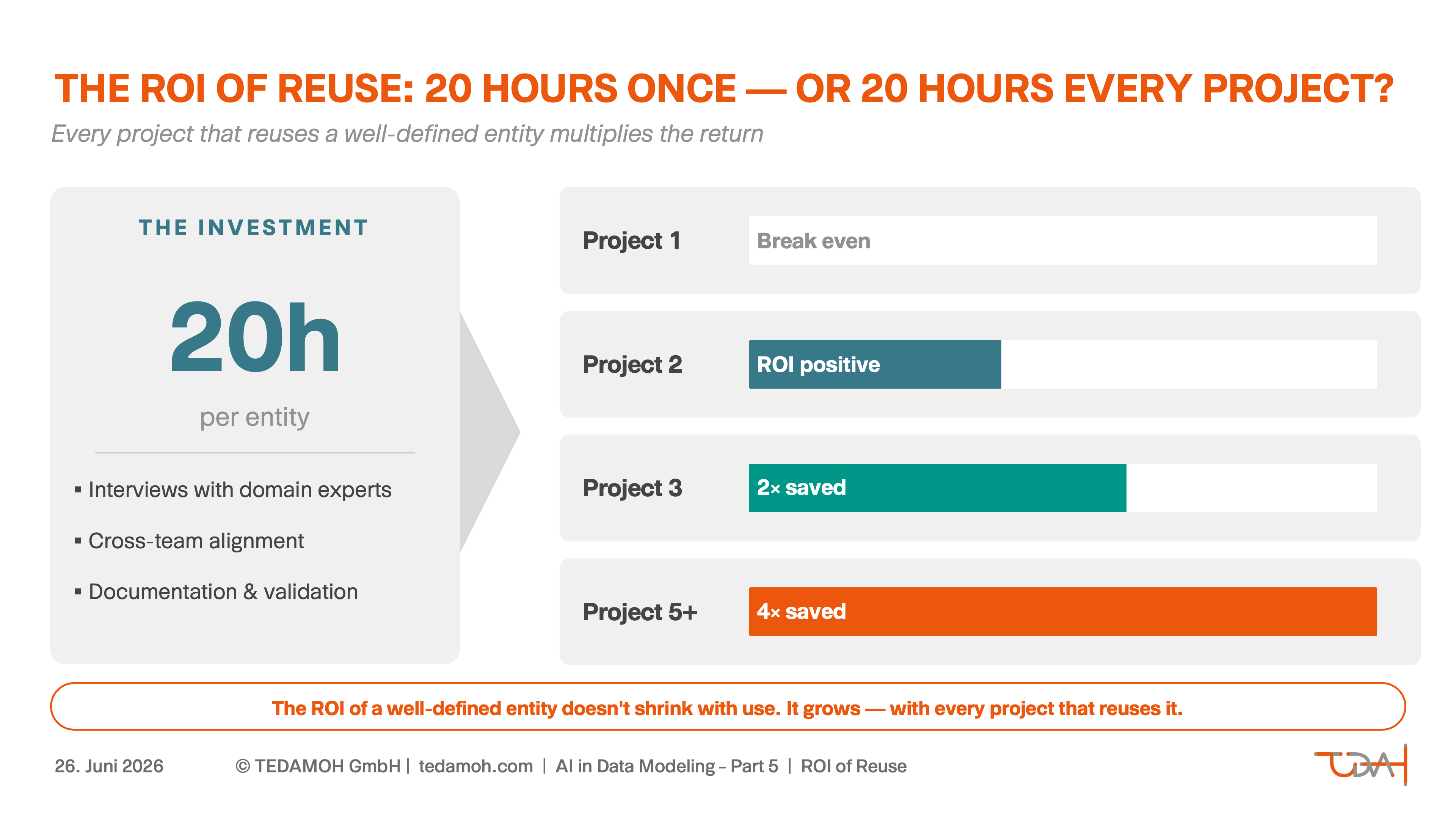
A simple example: carefully defining a single entity — interviews with domain experts, alignment, documentation, validation — takes roughly 20 hours. That sounds like effort. But every project that needs that entity and can't find it invests the same 20 hours again. By the second project, the return on investment for those original 20 hours is already positive. By the fifth project, you've saved four times the initial investment.
"And what does it cost when those seven definitions don't align?" asks Silvia.
Michael has worked that out too. Data cleanup after a failed system integration: six weeks of project work. Incorrect reporting figures that fed into decisions for three months before anyone noticed the inconsistency. An AI project stopped after four months of development because the training data came from three systems — with three different definitions of "customer."
These aren't disasters. They're silent costs that never appear in any project budget — and get paid anyway. Not once, but over and over again.
Want the complete series as a PDF? No problem! Get Data Modeling with AI as a free TEDAMOH Publication. Click the link below and save the series for later — read offline, share with your team, whatever works for you.
Download: Coming soon
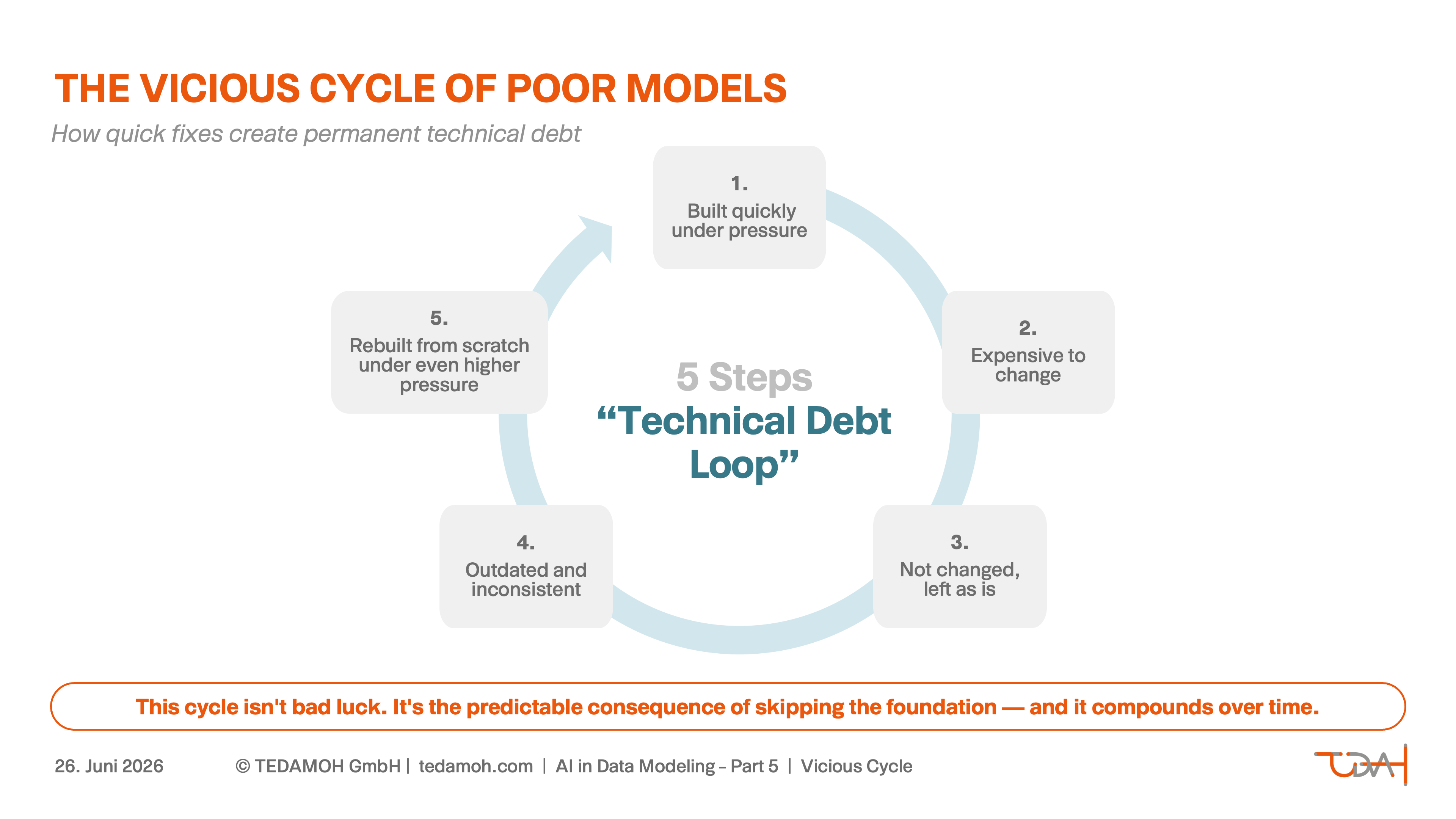 Then there's the vicious cycle of poor models: built quickly because pressure was high, expensive to change because the foundation is wrong — so it stays as it is, drifts out of date, and gets rebuilt eventually under even higher pressure and even less carefully. Anyone stuck in this cycle is permanently investing in technical debt instead of once in a solid foundation.
The silent risk
 "What's the worst-case scenario?" asks Silvia.
Michael thinks for a moment. "That we don't notice."
That's the real risk of poor or absent information models: it rarely shows up as a dramatic failure. It shows up as noise — projects that run slightly longer than planned, reports that differ slightly from each other, meetings where ten minutes go on clarifying terminology before the actual topic begins.
There are a few places where that noise tends to become genuinely expensive — not all at once, but reliably over time.
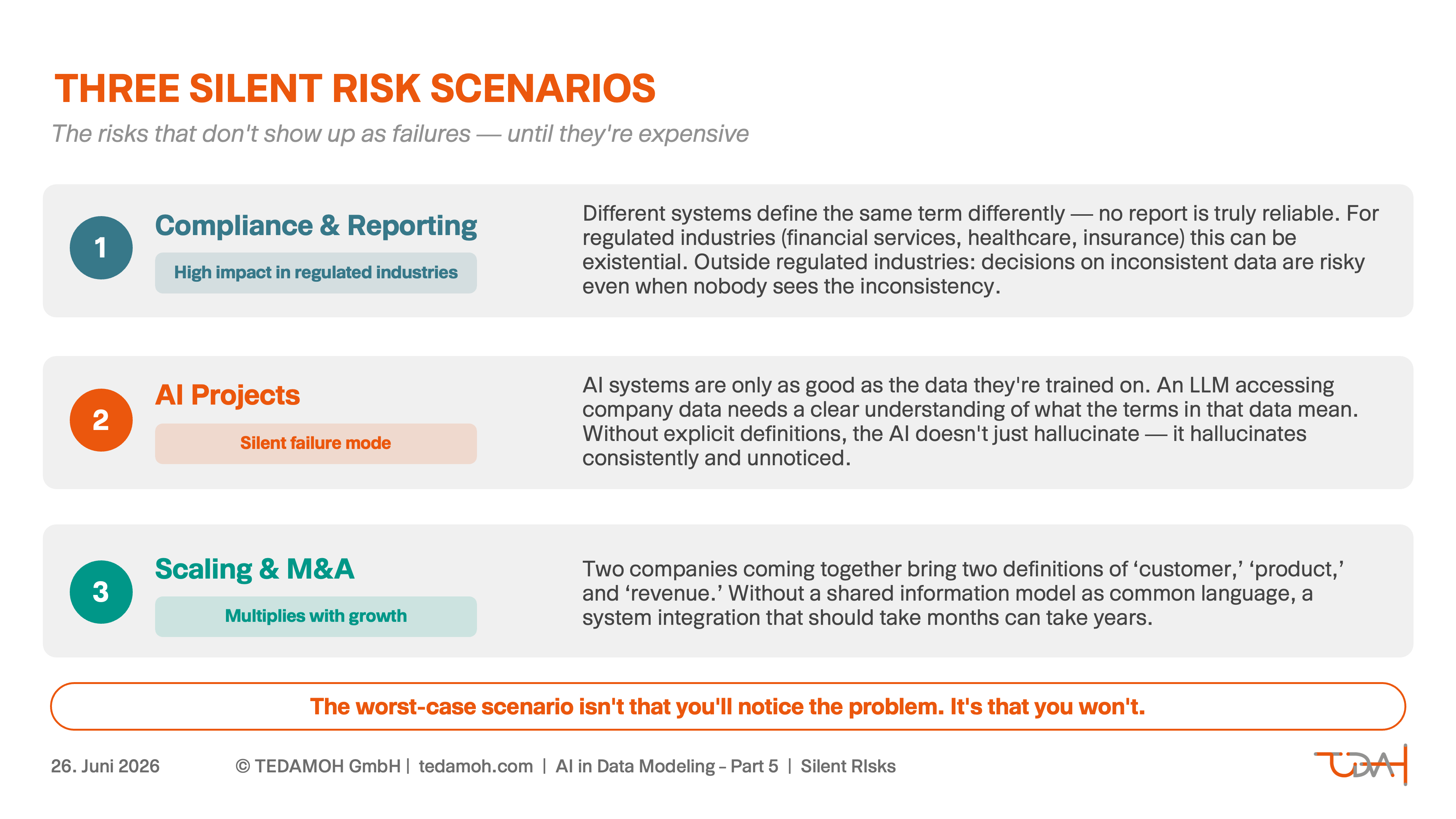
Compliance and reporting. When different systems define the same term differently, no report is truly reliable. For regulated industries — financial services, healthcare, insurance — this can have existential consequences. But outside regulated industries the same holds: decisions made on the basis of inconsistent data are risky, even when nobody sees the inconsistency.
AI projects. AI systems are only as good as the data they're trained or operated on. A large language model that should access company data needs a clear understanding of what the terms in that data mean. When that understanding is missing — because the organization itself never made it explicit — it's not just the AI that hallucinates. It hallucinates consistently and unnoticed.
Scaling and M&A. When an organization grows — organically or through acquisitions — the problem multiplies. Two companies coming together bring two different definitions of "customer," "product," and "revenue." Without an information model as a shared language, a system integration can take years that would have taken months with proper preparation.
How that quiet noise translates into a defensible business case is exactly what I work through in the strategy workshops with data management leads and C-level: what your data foundation already carries today, where the gaps are — and what ROI path follows from that.
About this series: This is the bonus article (Part 5) of our series on AI-assisted data modeling. Part 1 examines the fundamental paradox. Part 2 explains why generic automation fails. Part 3 walks through the hybrid 4-step workflow. Part 4 covers how the data modeler's role is evolving.
Seven projects, seven definitions of "customer" — sound familiar?
In the 2-hour strategy workshop with data management leads and C-level, we run exactly that case end to end: what inaction is already costing you, what a well-maintained information model returns in time-to-market and ROI — and where your biggest silent costs are hiding.
What management needs to decide
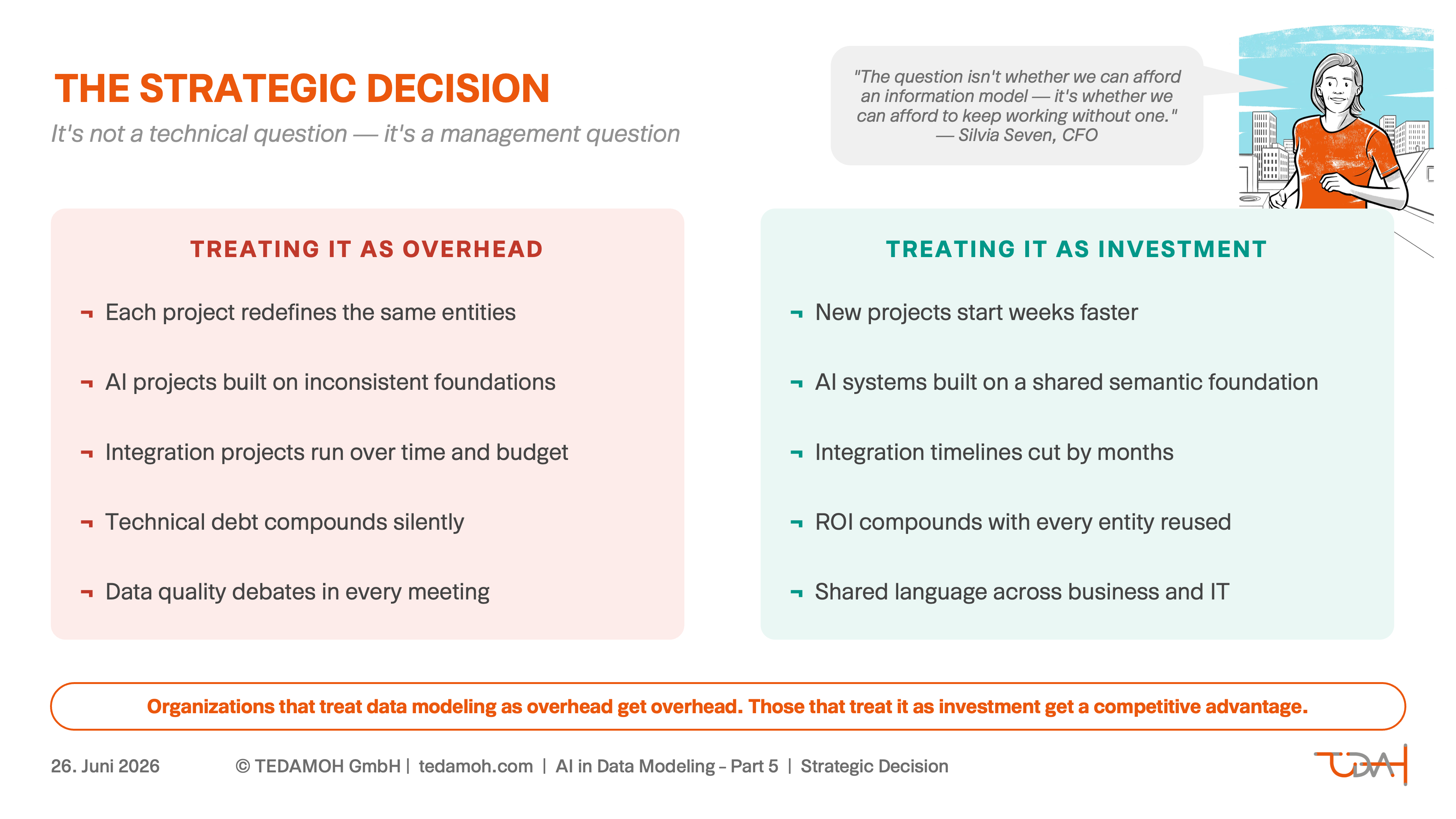 Silvia leans back. "So the question isn't whether we can afford an information model. The question is whether we can afford to keep working without one."
That's the whole point. The decision for or against a well-maintained information model is not a technical one — it's strategic. It shapes how quickly an organization can respond to new requirements, how much groundwork every project repeats that should already have been done, and whether AI projects stand on solid ground or on gravel.
Organizations that treat data modeling as overhead get overhead. Those that treat it as an investment get a competitive advantage — one that compounds with every reuse of a well-defined entity.
And with AI support, the barrier that kept many teams from doing this at all has come down — the manual grind that made it feel impossible alongside a live project. That excuse is gone. What's left is deciding whether to use the opening.
Once the strategic decision is made, the Data Modeling Training brings your team up to speed in a few days — in-house if you prefer.
So long,
Dirk